
Case Report
August 2026, 35:2
First online: 17 August 2026
Case Report
Retrograde Direct Wire Crossing of Stumpless LAD CTO via Ipsilateral Collateral Using Portal Technique and Ping-Pong Guide Catheter
Hou Tee Lu,1 Vicknesan Kulasingham,1 Azrina Bt Abdul Kadir,1 Kim Heng Shee,1 Gurudevan Mahadevan 1
Telephone number: +6072257000
Fax number: +6072244684
Main Author: Hou Tee Lu
Email Address: luhoutee@gmail.com

ABSTRACT
Proximal cap ambiguity in chronic total occlusion (CTO) is associated with increased procedural complexity, lower success rates, longer procedure time and greater use of retrograde approaches. Conventional angiography makes it challenging for interventionists to accurately identify the entry point, easily misdirecting the GW into the subintimal space, leading to PCI failure. We reported a 45-year old male with CTO of the mid left anterior descending artery (LAD) with an ambiguous proximal cap. We used a Ping-Pong technique with two guide catheters (GC)s and intravascular ultrasound (IVUS) was used to identify the proximal cap. Retrograde wiring was performed through an ipsilateral collateral from diagonal artery, successfully crossed the LAD CTO and externalized into the antegrade GC. Firstly, the rendezvous and “tip-in” method were used, followed by the kissing microcatheter (MC) and chasing wires technique, which successfully revascularized the CTO.
Key word:chronic total occlusion; retrograde; ipsilateral collateral; rendezvous technique; ping-pong guide catheters
INTRODUCTION
Percutaneous coronary intervention (PCI) for stumpless chronic total occlusion (CTO) is still a challenge today. We report a case of left anterior descending artery (LAD) CTO with ambiguous proximal cap treated successful using intravascular ultrasound (IVUS) guided puncture, a retrograde approach via the ipsilateral (IL) collateral, and ping-pong guide catheters (GC). The portal technique (including rendezvous and “tip in” technique) was used to avoid the pitfalls of the classic externalization wire technique.1
CASE REPORT
A 45-year-old man, a smoker with hypertension presented with recurrent angina. The exercise stress test was positive. His left ventricular function was normal. Angiography performed at another hospital showed mid-LAD CTO with an ambiguous proximal cap (Figure 1A, 1B). The diagonal artery (D1) exhibited 70% stenosis, the dominant right coronary artery (RCA) had 90% stenosis (Figure 1C), and the mid-left circumflex artery (LCx) showed 50% stenosis. The LAD CTO received two collateral channels (CC)s: 1) contralateral epicardial collateral (CC1) from a right posterior descending artery (PDA) (Figure 1D) and 2) IL collateral (CC1) from D1 (Figure 1A). The LAD CTO appeared non-calcified, non-tortuous, and longer than 20 mm with a significant course ambiguity. The D1 seamlessly continues into the ostial LAD, there was no clue where the proximal cap of the LAD CTO originates. The J-CTO score was 2. The SYNTAX score was 19. The patient declined coronary artery bypass graft surgery (CABG).
First attempt
Bifemoral access was obtained. The left main artery was engaged with 7F EBU 3.5 GC, while the RCA was engaged with a 7Fr JR 4.0 GC. First, the RCA and D1 lesions were treated with a drug-eluting stent (DES) and drug-coated balloon (DCB), respectively. PCI attempts on LAD CTO antegradely encountered great difficulty. A Sion Blue guide wire (GW) was delivered to D1. With the SASUKE double-lumen microcatheter (DLMC), a GAIA First GW was sent to the LAD occlusion along the front of the side-hole to puncture the “presumed” proximal cap but went into subintimal space. We switched to a retrograde approach by wiring the right PDA epicardial CC to the distal LAD successfully using a SUOH03, followed by a CARAVEL 150 cm microcatheter (MC) (Figure 1E). However, retrograde wire escalation (using Fielder XTR, GAIA 2nd and Pilot 200) was unsuccessful (Figure 1F). Two main reasons for failure were: 1. Inability to solve the proximal cap ambiguity and 2. failure of the retrograde wire to puncture the CTO distal cap. We planned a staged procedure three months later.
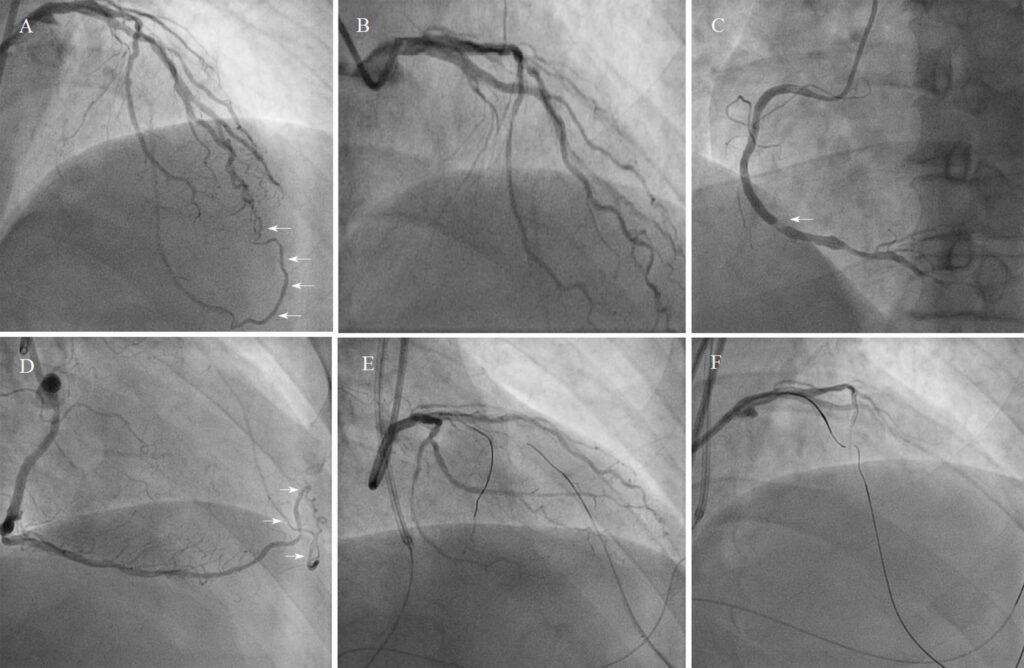
1A & B: The mid left anterior descending artery CTO and ipsilateral collateral (white arrow) from diagonal artery
1B: The mid left anterior descending artery was totally occluded just distal to the diagonal branch and the stump was hardly recognizable (black arrow)
1C: Distal RCA 90% stenosis (white arrow)
1D: Tortous epicadial collateral (white arrow) from right posterior descending artery to LAD
1E & F: Retorgrade wire failed to puncture distal cap
Second attempt (IVUS-guided proximal cap puncture and ipsilateral retrograde approach)
We used the “ping-pong” technique (using two GCs engaging the same coronary ostium). An EBU 3.5 7Fr GC was used for the LAD CTO antegrade approach. An EBU 3.0 6Fr was used for wiring the D1 for IVUS-guided puncture. Dual injection was performed (Figure 2A). The IVUS catheter was placed in the D1 nearest the proximal cap and withdrawn to identify the ambiguous proximal cap (Figure 2C). Guided by SASUKE DLMC, the antegrade GAIA 2nd advanced into the presumed proximal cap via the side-hole of SASUKE. The SASUKE was exchanged for a 135 cm Corsair MC. The antegrade GAIA 2nd went into subintimal as seen in contralateral injection (Figure 2B). We switched to retrograde approach. The MC tip injection at distal D1 revealed IL circulation connection with distal LAD (Figure 2B). A SUOHO3 GW successfully crossed the IL epicardial pathway into distal LAD followed by a CARAVEL MC (150 cm). The retrograde UltimateBro3 (UB3) wire successfully puncture the distal cap, tracked the loose tissue, navigating its way to cross the CTO body into proximal LAD and entered antegrade GC (Figure 2D, 2E). Instead of using RG3 for classical externalization, we used the rendezvous and “tip in” method to minimize IL collateral shear stress.1 The retrograde UB3 was successfully wired into the antegrade CorsairPro MC by “tip in” at the convex part (greater curvature) of the antegrade GC (Figure 2F). Then, the antegrade CorsairPro was advanced into LAD but failed to cross the CTO body. We did a second “tip-in” at the level of the CTO body by moving the tips of antegrade and retrograde MC close to each other (rendezvous and kissing MC technique).1 While pushing the antegrade SION wire in a forward manner, the retrograde UB3 wire was retracted simultaneously (chasing wire technique)2 (Figure 3A). The antegrade SION successfully entered retrograde CARAVEL. IVUS confirmed the antegrade GW was in true lumen. A mini-crush stent deployment technique was employed to treat the CTO and bifurcation lesions, utilizing a 3.5 mm and a 2.75×24 mm DES in the LAD and D1, respectively, and concluded with a kissing balloon technique. (Figure 3B, 3C).
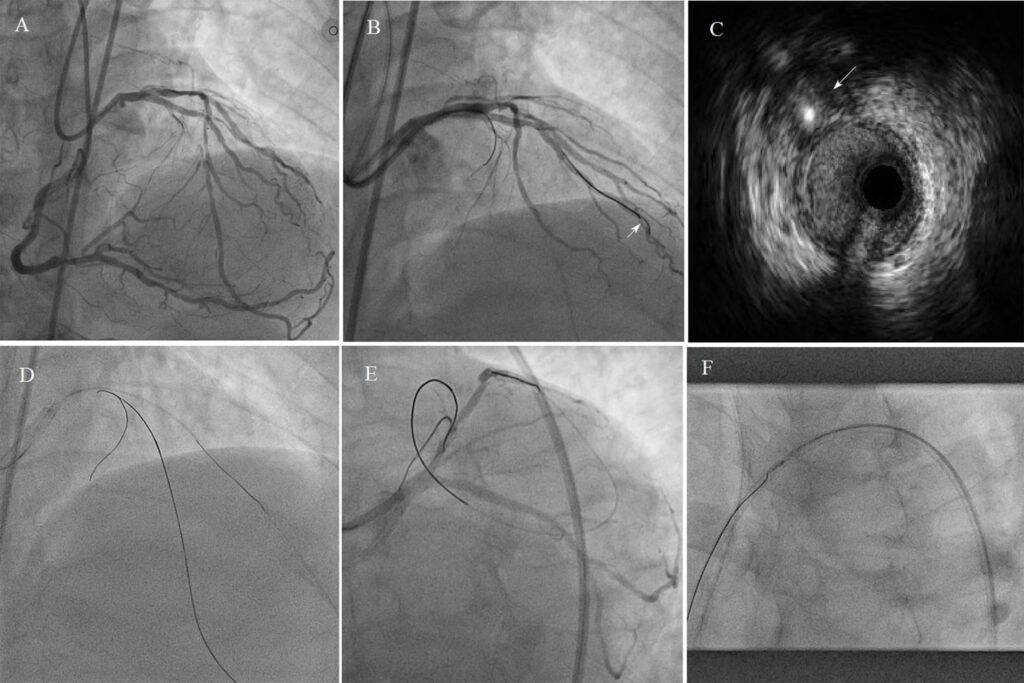
2A: Dual injection
2B: Ipsilateral collateral wiring from diagonal artery (white arrow)
2C: IVUS catheter pull back from diagonal artery indicate retrograde wire in CTO true lumen (white arrow)
2D & E: Retrograde wire successfully entered proximal LAD true lumen
2F: The first tip in at at the greater curvature of the antegrade EBU 3.5 G
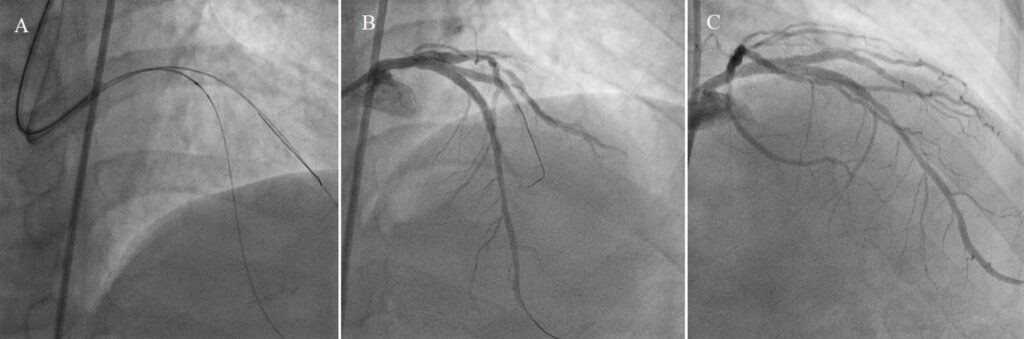
3A: The second tip in at CTO body by MC kissing technique and chasing wire technique (white arrow)
3B & C: Mini Crush to treat the CTO and bifurcation lesions
DISCUSSION
Proximal cap ambiguity is present in one-third of CTO-PCI target lesions, associated with lower success rates, and higher utilization of retrograde approach.3 Using conventional angiography alone is hard to identify the entry point, increasing the risk of guidewire misdirection into the subintimal space and potential PCI failure. The CTO PCI hybrid algorithm addresses proximal cap ambiguity using better angiography, CTCA, IVUS, or “move the cap” techniques; if antegrade wire crossing fails, a retrograde approach is considered.4, 5 IVUS-guided wiring helps resolve proximal ambiguity but has limitations: it requires an 8 Fr GC to fit both the IVUS catheter and MC simultaneously. A shorter tip IVUS catheters are preferred but not commonly available, and the procedure demands operator expertise and real-time image interpretation. An 8 Fr GC is not always available. It carries higher risks of ostium injury and puncture site bleeding. Therefore, the ping-pong GC technique is preferred over the 8 Fr GC. Furthermore, the single lumen of an 8 Fr GC can cause interference among MCs, GWs, and IVUS, complicating the wire manipulation. In contrast, the 6 Fr and 7 Fr ping pong GCs have two lumens, allowing them to accommodate an IVUS catheter alongside larger MCs simultaneously. This technique reduces the risk of GW loss, provides flexibility in switching strategies during PCI, and can facilitate the externalization of the retrograde GW.6 These advantages may increase the success rate in retrograde CTO PCI via IL collateral channels.7 IL CCs are visible in 30% of CTO but are less preferred for retrograde approaches due to the risk of vessel rupture from their tortuous epicardial course and sharp distal entry angles.8 In the second attempt, a shorter, less tortuous IL collateral from D1 was chosen over the longer, more tortuous CC from the right PDA used initially.
The classic externalization wire technique can be challenging in heavily calcified CTO or tortuous collaterals, and potentially leads to complications, such as MC entrapment or collateral injury.1, 9 In our case, we chose the “tip-in”, rendezvous and chasing wire techniques to achieve connection, allowing the procedure to be completed antegradely. The various retrograde-antegrade connection techniques to establish retrograde GW connection and antegrade conversion known as portal techniques are gaining popularity among interventionists.1
CONCLUSION
Stumpless CTO PCI remains technically challenging due to the difficulty of locating a suitable entry point. Hybrid strategy and the use of intravascular imaging enhance the procedural safety and success. It is feasible to use an ipsilateral collateral for retrograde conduit assisted by ping-pong guide catheters. The Portal technique serves as strategic advantages in retrograde CTO PCI, providing an alternative solution to the classic wire externalization technique.
Author contributions
All authors were involved in the clinical care and procedures performed on the patient.
Hou Tee Lu took the lead in writing and revising the manuscript. All authors contributed to the article and approved the submitted version.
Acknowledgement
The authors would like to acknowledge the catheterization laboratory nursing staffs for the excellent team work and good clinical care.
Competing interest
The authors declare that they have no competing interests.
Funding information
This case report received no specific grant from any funding agency.
Ethics statement and patient consent
Written informed consent was obtained from patient for the purpose of this publication.
REFERENCES
1. Ungureanu C, Avran A, Brilakis ES: Comprehensive Overview of
Retrograde-Antegrade Connection Techniques Without Externalization in Chronic Total Occlusion PCI. The Portal Techniques. Catheterization and Cardiovascular Interventions. 2024; 1–12. CrossRef Pubmed
2. Nakabayashi K, Sunaga D, Kaneko N, Matsui A: The wire rendezvous and chasing wire technique in the bidirectional approach for the percutaneous coronary intervention for chronic total occlusion with a single guiding catheter. Case Reports in Cardiology 2018;Oct 30:7162949. CrossRef Pubmed
3. Karatasakis A: Impact of proximal cap ambiguity on outcomes of chronic total occlusion percutaneous coronary intervention: Insights from a multicenter US registry. J Invasive Cardiol 2016; Oct 28 (10):391–396. Pubmed
4. Wu EB, Tsuchikane E, Lo S: The retrograde algorithm for chronic total occlusion from the Asia Pacific Chronic Total Occlusion Club. Asian Interv 2018;4:98–107. Pubmed
5. Brilakis ES: Manual of Chronic Total Occlusion Interventions. A Step-by-Step Approach. 2017; November 25.
6. Ching Tang C, Lee WH, Kuo HF, Mark ZC , Hsu PC: Ping-Pong guiding catheters to facilitate Real-Time IVUS guided recanalization of stumpless left anterior descedning artery CTO. JACC Case report 2019; Vol. 1: No. 5. CrossRef Pubmed
7. Brilakis ES, Grantham JA, Banerjee S: “Pingpong” guide catheter technique for retrograde intervention of a chronic total occlusion through an ipsilateral collateral. Catheterization and Cardiovascular Interventions 2011; 78:395–9. CrossRef Pubmed
8. Mashayekhi K, Behnes M, Valuckiene Z, Bryniarski L: Comparison of the ipsi-Lateral versus contra-lateral retrograde approach of percutaneous coronary interventions in chronic total occlusions. Catheterization and Cardiovascular Interventions 2017;89(4):649–655. CrossRef Pubmed
9. Kim MH, Yu LH, and Mitsudo K: A new retrograde wiring technique for chronic total occlusion, Catheterization and Cardiovascular Interventions 2010; 75:117–119. CrossRef Pubmed
Copyright Information